If we need more space, why not just lease another warehouse or commercial premises instead of putting up a large marquee on site?
Because long-term marquee hire often gives the business extra space exactly where it is needed, without the extra rent, split operations, and long-term commitment that usually come with another premises. For many clients, it is simply the more direct and flexible way to solve the problem.
What is the real downside of leasing another premises?
On paper, leasing another warehouse or building can sound straightforward. More space is more space. But in practice, a second premises often creates a whole new set of operational problems.
It can mean:
- extra rent
- extra utilities
- transport between sites
- split supervision
- duplicated movement of stock or equipment
- less control over the way the operation is flowing
- commitment to a lease period that may outlast the original need
That may still be the right option in some cases, but it is not automatically the better answer just because it sounds more permanent.
A lot of businesses do not actually need a separate second site. They need more room near the operation they already have. That is a very different problem, and a marquee often solves it much more directly.
Why is adding the space on-site such a big advantage?
Because proximity matters more than people think.
If the extra warehouse or operational space is right beside the current premises, then:
- stock stays close
- staff movement stays simpler
- supervision is easier
- loading and unloading remain integrated
- the business does not split itself across multiple addresses
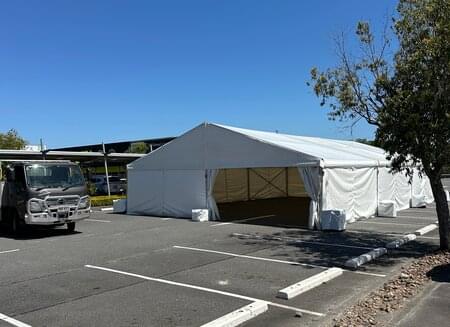
That is a huge operational benefit. Many clients are not simply looking for “space somewhere.” They need space where the rest of the operation already is. If the extra area can be created on-site or directly adjacent to it, then the business often runs far more smoothly than it would if overflow had to be pushed into a separate leased facility.
This is especially true for:
- logistics operations
- retail overflow
- temporary project support
- workshop or maintenance use
- project-based stockholding
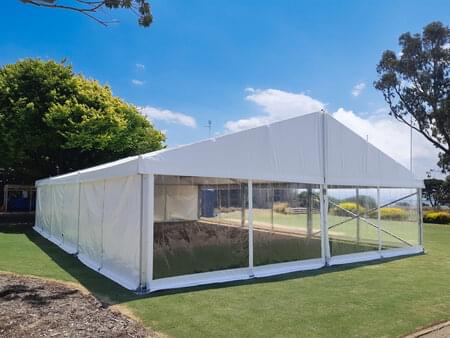
The marquee becomes a practical extension of the current operation, not an entirely separate site to manage.
Is long-term marquee hire mainly about speed?
Speed is a major part of it, yes, but not the whole story.
A permanent building extension or a separate lease may both take time, and sometimes that time is the main issue. If the business needs additional space now, a marquee can often be installed much faster and begin solving the operational pressure almost immediately once the approvals and planning are in place.
But beyond speed, the marquee also gives flexibility. If the client only needs the extra space for:
- one project cycle
- one peak season
- one refurbishment period
- one uncertain growth phase
then taking on another premises or committing to permanent construction can be a much heavier decision than necessary.
Long-term marquee hire lets the client solve the problem now without forcing them to commit too early to what the answer must be forever.
What about cost — is a marquee always cheaper?
Not automatically in every single scenario, and we would not pretend otherwise. But it often provides better value when the business needs temporary or flexible extra space.
The key comparison is not just “monthly hire versus lease cost.” It is:
- how fast the solution can start working
- whether it keeps the operation close together
- whether it can be resized later
- whether it avoids tying the client into a longer property commitment
- whether it avoids larger capital expenditure on permanent works too early
In many real-world cases, those factors make the marquee the smarter commercial answer even before the raw cost is compared line by line.
What if the business is not sure how long the extra space will be needed?
That is exactly the sort of situation where marquee hire tends to make the most sense.
If the business knows with certainty that it needs a second premises for many years, then leasing or building may be worth considering. But if the need is connected to:
- project growth
- temporary stock pressure
- infrastructure works
- uncertain demand
- refurbishment
- seasonal expansion
then a modular marquee gives the business room to make that longer-term decision later rather than forcing it now.
That is one of the reasons clients like the flexibility of monthly hire arrangements. They can keep the structure as long as it is useful and adapt if the project changes.
Why do clients sometimes feel more confident choosing a marquee?
Because it is reversible and adaptable.
A leased site comes with commitment. Permanent construction comes with commitment. A modular marquee still needs planning and investment, of course, but it gives the client more room to adjust later if:
- the project ends
- the need reduces
- the site changes
- the business decides to move in a different direction
That flexibility is often exactly what makes the decision easier.
The better question is not whether another premises sounds more “solid” than a marquee. The better question is which option actually solves the business problem in the smartest way right now. For many clients, long-term marquee hire gives them the extra space faster, closer, and with far more flexibility than a separate leased premises ever could.