
If our site is not a perfect flat slab, is that going to turn into a major problem later, or can the marquee still be installed safely and work properly for the whole project?
Yes, these structures can absolutely be installed on concrete, hardstand, gravel, grass, and gently sloping ground, as long as the site is assessed properly and the installation method is matched to the actual conditions. The important thing is not whether the site is perfect, but whether the marquee is planned and anchored correctly for the way that site works.
Does the type of surface really make that much difference?
Yes, but usually not in the dramatic way clients first imagine. A difficult surface does not automatically mean a difficult project. What it really means is that the marquee needs to be approached the right way from the beginning.
When clients first ask this question, they often worry that unless the site is a clean, level concrete slab, the whole idea might be unrealistic. In practice, that is not usually the case. A lot of long-term warehouse, retail, and operational projects happen on sites that are already imperfect. They might be on:
- concrete hardstand
- bitumen
- gravel yards
- grassed areas
- mixed-surface industrial sites
- gently sloping land beside an existing warehouse or retail premises
That is very normal.
The main thing we need to understand is how the site behaves operationally. For example:
- where trucks need to move
- whether forklifts will be used
- what routes must stay clear
- whether overhead services need to be avoided
- how the structure will be anchored
- whether water movement or drainage needs attention
That is why the site surface matters. Not because one surface is automatically good and another automatically bad, but because each one changes the installation method and the planning around it.
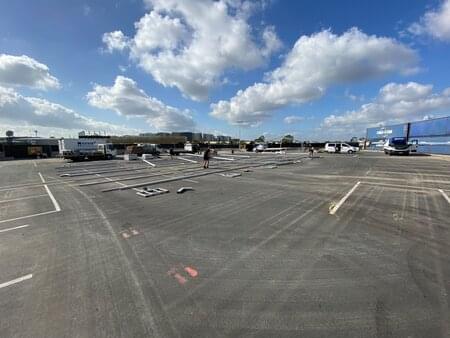
How do you install a warehouse marquee on concrete or hardstand?
Usually with ballast rather than ground penetration.
On concrete or hardstand, we commonly secure larger warehouse marquees with substantial concrete ballast blocks, delivered to site by truck and positioned to meet the structural engineering requirements for that specific build. On larger projects, those blocks can be very substantial, and for good reason. The marquee needs to remain stable over long periods and through real weather conditions, not just look secure on installation day.
That usually means planning for:
- ballast delivery
- truck access
- safe movement of heavy blocks
- forklifts or cranes if required
- enough working room around the structure during install
Sometimes we bring the required equipment ourselves. Other times, the client may allow us to use their forklifts or cranes on site. That can be helpful because it may reduce cost and simplify the logistics, provided it is done safely and with clear planning. We are always open to practical solutions like that because most commercial clients are understandably conscious of budget. If there is a sensible way to reduce cost without affecting safety or the quality of the build, we will usually explore it with them.
The important thing is that on hardstand, the marquee is not simply being “placed there.” It is being engineered and secured in a way that suits that surface.
What about gravel, grass, or more open industrial sites?
These are often very workable too.
On gravel or grass, we can often use:
- ground anchors
- steel pegs
- other anchoring methods depending on the site and the engineering
In many ways, those sites can be easier because the anchoring may be more direct than on hardstand, where heavy ballast is needed. But they also bring their own questions:
- how stable is the ground over time
- will vehicles be moving nearby
- does the site become soft or difficult after rain
- is the marquee location interfering with other site access needs
That is why we look at the whole site, not just the patch of ground directly under the structure. If a marquee is going to remain in place for six months, twelve months, or longer, it needs to sit somewhere that still makes sense operationally once the initial urgency of the project has passed.
Clients sometimes assume grass or gravel automatically sounds more temporary or less suitable than concrete. That is not really the right way to look at it. The right question is whether the structure can be anchored safely and whether the site around it will continue to function properly while the marquee is in use.
Can a marquee still be installed on uneven or sloping ground?
Often yes, particularly if the slope is gentle and the site is understood early enough.
A lot of clients assume uneven ground means they need to abandon the idea completely, but that is not usually necessary. Sloping sites simply require more planning. We look at:
- how pronounced the slope is
- where the access points need to be
- whether the structure needs flooring
- how vehicles and staff will move around it
- what the final operational use is
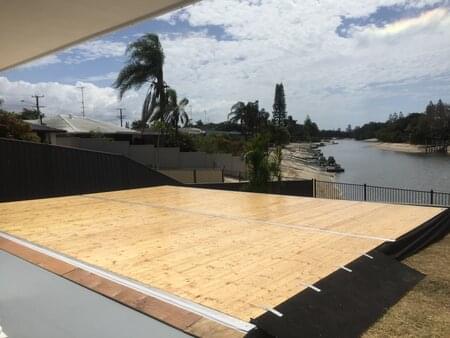
For some projects, gentle slopes are not a problem at all. For others, the marquee may need to be positioned a little differently to improve access and usability. Where flooring is required, especially if the client needs a more controlled internal working surface, that can also help address some of the practical issues created by uneven ground.
The key point is that slope does not automatically mean “no.” It means the site needs to be reviewed properly before the final solution is agreed.
Why are site meetings so important on these projects?
Because they remove late surprises.
For larger long-term warehouse and retail marquee jobs, we strongly prefer to meet the client on site before installation. That gives us the chance to work through:
- access for trucks
- likely anchoring methods
- where ballast may need to sit
- whether forklifts or cranes are needed
- which operational routes must stay open
- whether the marquee risks interfering with power lines, services, or circulation paths
A lot of the problems people associate with difficult sites do not actually come from the surface itself. They come from poor site planning. If those things are picked up early, the project usually feels far more straightforward.
It also gives the client confidence. They can see that the project is being thought about in practical terms, not just sold off a drawing.
What happens after installation — is the structure checked again?
Yes, in many larger long-term projects the completed build is inspected by structural engineers and certified once installed. That is a very important step because it confirms the structure has not only been designed properly, but also assembled and secured properly on the actual site conditions it is facing.
That is especially valuable on more complex surfaces or where the project is likely to remain on site for extended periods. It gives the client confidence that the marquee is:
- standing correctly
- compliant with the required engineering standard
- suitable for the intended long-term use
For commercial buyers, that matters a lot. They are often accountable internally and need more than just a verbal reassurance from the installer.
Does surface type affect cost or installation speed?
Yes, sometimes.
A hardstand site with large ballast blocks and tighter access may cost more than a simple gravel site using anchors. A site that requires cranes, forklifts, or more labour will usually affect installation cost as well. But that does not mean the project becomes poor value. It just means the build method needs to reflect the site reality.
The most important thing is honesty early. We would rather explain what the site requires properly than pretend all surfaces are equal and let the cost or logistics surprise the client later. In our experience, commercial clients appreciate that. They are generally fine with practical answers. What they dislike is discovering complications only after the job is meant to have started.
A site does not need to be perfect for a long-term marquee project to work well. Concrete, hardstand, gravel, grass, and gently sloping ground can all be workable if the structure is designed, anchored, and planned around the real conditions. The site type changes the method, but it does not usually stop the project. What matters is getting that method right from the beginning.